
TL;DR
- What it is: Model serving is the runtime layer that takes a live request and returns a model’s output inside a decision’s time budget. It is a different problem from deployment, which is about getting a model into production in the first place.
- The core problem: A model that scores well in validation can still be useless in production if the serving layer cannot return an answer before the decision window closes.
- What changes: Which serving pattern, batch or real-time, actually fits a given decision, where a latency budget gets spent across the request path, and what RBI’s draft framework expects a production serving environment to prove.
- What doesn’t change: A model’s accuracy on paper does not change based on how it is served. What changes is whether that accuracy actually reaches the decision in time to matter.
- Honest caveat: RBI’s draft guidance referenced below is still under review and not yet in force, so treat its production-stability language as the direction serving architecture is heading, not a finalized mandate.
A model that performs well in validation can still fail in production for a reason that has nothing to do with its accuracy: it takes too long to answer. A collections model that needs three seconds to score a borrower is not useful for a decision that has to happen the moment a payment event fires.
Model serving is the layer that determines whether a model’s output actually arrives in time. This page covers what serving means as distinct from deployment, the real trade-off between batch and real-time serving, where a latency budget gets spent across a request and where it typically breaks, and what RBI’s draft framework expects a production serving environment to prove.
This is a narrower question than the deployment lifecycle overall. Our own piece on model deployment in regulated environments covers the validation, approval and change-management gates a model has to pass before it goes live. This page picks up after that: once a model is live, what determines whether it can actually keep up with the decisions it was built for.
What “model serving” means, and why decision latency is the constraint that actually matters
Model serving is the runtime layer that takes a live request, such as a borrower’s current account data, and returns the model’s output inside a decision’s available time window. Deployment gets a model into production once. Serving is what happens every single time a decision needs that model’s answer.
A model can pass every validation and approval gate and still fail at serving if the infrastructure around it cannot return a scored output before the decision window closes. Accuracy and speed are measured separately, and a serving layer that is slow does not show up as an accuracy problem in any offline test.
Decision latency is the actual time budget a specific decision has, not a generic performance target. A same-day batch report can tolerate minutes. A real-time collections trigger fired the moment a payment event lands typically needs an answer in well under a second, because the moment it is responding to has already started passing.
Batch vs. real-time serving: the trade-off a lending or collections decision actually forces
Batch serving scores a set of accounts on a fixed schedule and stores the results for later use. Real-time serving scores one account at the exact moment a decision is needed, using whatever data is current at that instant. Neither is universally better. The decision’s own time budget determines which one fits.
A monthly credit review can run on batch serving without losing anything, since nothing about that decision depends on the account’s state in the last few minutes. A collections trigger tied to a specific payment event loses most of its value if it waits for the next scheduled batch run, because the borrower’s propensity to respond was highest at the moment the event happened, not hours later.
This is a different question from the one our own piece on real-time decisioning for digital lenders in India answers. That page covers the collections business logic of deciding what to do at the moment of an event. This page covers the infrastructure question underneath it: what has to be true about the serving layer for that moment-of-event decision to be technically possible at all.
Choosing real-time serving when batch would do adds infrastructure cost and complexity for no decision-quality benefit. Choosing batch when a decision genuinely needs the moment of the event throws away most of the value the model was built to capture.
Where a latency budget actually gets spent, and where it breaks
A decision’s latency budget gets consumed across four stages: retrieving the current feature data, moving the request over the network to wherever the model runs, the model’s own compute time, and any post-processing before the output reaches whoever acts on it. Each stage can independently blow the budget even when the others are fast.
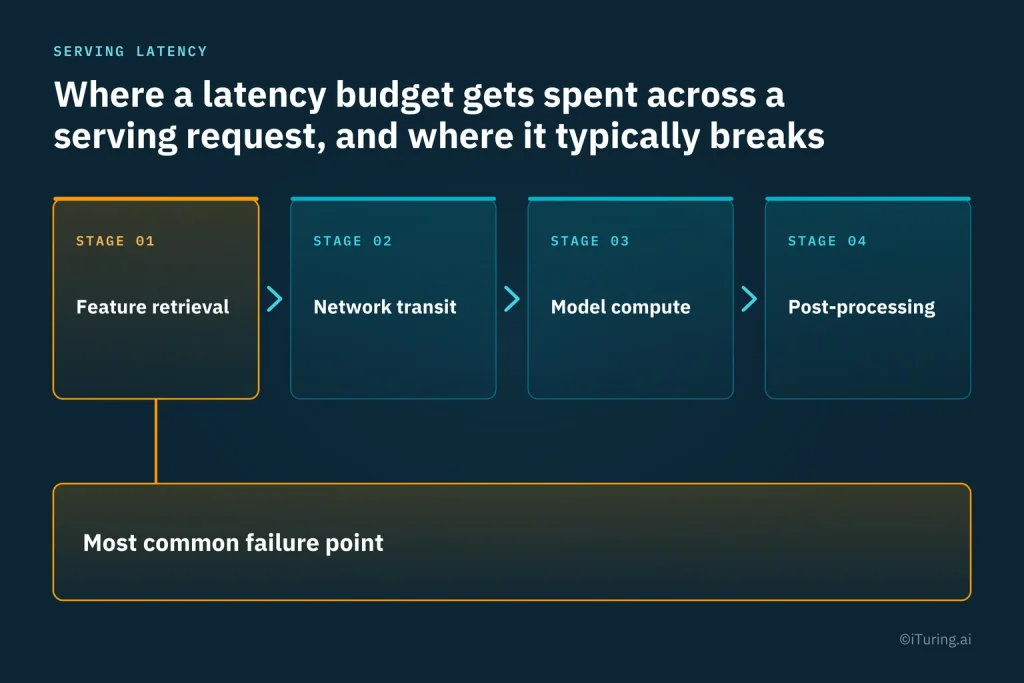
Feature retrieval is the most common failure point, not the model itself. A model that scores in milliseconds is still slow overall if the system feeding it current account data takes seconds to assemble that data from several source systems. This is exactly the kind of gap a well-built data pipeline, with lineage and access already in place, is meant to close.
Network hops between where a request originates and where the model actually runs add latency that scales with distance and with how many separate services a request has to pass through. A serving architecture with fewer hops between the triggering event and the model is not a luxury. It is often the single biggest lever on whether a real-time decision is achievable at all.
What RBI’s draft guidance requires of a production serving environment
RBI’s draft Guidance on Regulatory Principles for Model Risk Management requires that a model’s outputs in the live production environment be replicated and stable, matching what the validation process observed before deployment. A serving layer that returns different results under production load than it did in testing has not met this requirement, regardless of how fast it responds.
The same guidance sets a material-change threshold that re-triggers validation and approval when a change crosses it. Moving a model from batch to real-time serving, or re-architecting the serving layer to cut latency, is exactly the kind of infrastructure change that can qualify as material, since it can alter what data the model sees and when, not just how fast it responds.
A serving change made purely for speed can still change what the model actually does in production. Cutting a network hop by skipping a feature-validation step, for instance, might improve latency while quietly changing which inputs the model sees, which is the kind of change this threshold exists to catch before it reaches production unnoticed.
What a properly served model actually delivers
A properly served model closes the gap between what a model can do in theory and what it actually delivers the moment a decision needs it. iTuring’s own platform-native serving layer was part of a live NBFC collections deployment.
That deployment reached production in two weeks, with the model already meeting its decision-latency requirement rather than being tuned for speed afterward.
That deployment delivered a 116% improvement in collections recovery rate and 86% predictive accuracy, outcomes that depend on the model’s output actually reaching the decision in time, not only on the model’s accuracy in isolation. A model with the same accuracy served too slowly would not have produced the same result.
If your current serving layer can’t tell you where its latency budget actually goes, book a working session with our team to map where the gaps are.
Questions to ask before choosing a serving pattern
Before committing to batch or real-time serving for a given decision, work through what the decision actually needs, not what infrastructure is already available.
- What is the decision’s real time budget? Ask how much value the decision loses for every minute, or second, it waits, not what response time sounds technically impressive.
- Where does the latency actually get spent today? Measure feature retrieval, network transit, model compute and post-processing separately, since fixing the wrong stage wastes effort.
- Does the serving layer return stable results under production load? Compare live production output against what validation observed, not just against a staging environment.
- Would this serving pattern qualify as a material change? Check any change to how or when a model is served against the institution’s own change-management threshold before rolling it out.
- Is real-time serving actually required, or just familiar? Confirm the decision genuinely depends on the moment of an event before paying for real-time infrastructure a batch schedule could serve just as well.
Sources
- Reserve Bank of India, “RBI issues draft ‘Guidance on Regulatory Principles for Model Risk Management’,” Press Release 2026-2027/528, 24 June 2026. https://www.rbi.org.in/scripts/BS_PressReleaseDisplay.aspx?prid=63006
- Reserve Bank of India, Draft Guidance on Regulatory Principles for Model Risk Management (guidance document), paragraphs 36, 38-42. https://www.rbi.org.in/Scripts/bs_viewcontent.aspx?Id=5089
- iTuring case study, “Improve Collections and Optimize Efforts” (leading NBFC in India): 116% collections improvement, 86% predictive accuracy, two-week deployment. https://ituring.ai/case-study/improve-collections-and-optimize-efforts/
- iTuring.ai, ModelOps platform page. https://ituring.ai/platforms/model-ops/