


Collections Cost Benchmarking for Indian NBFCs: AI vs Manual Agent Economics in 2025-2026
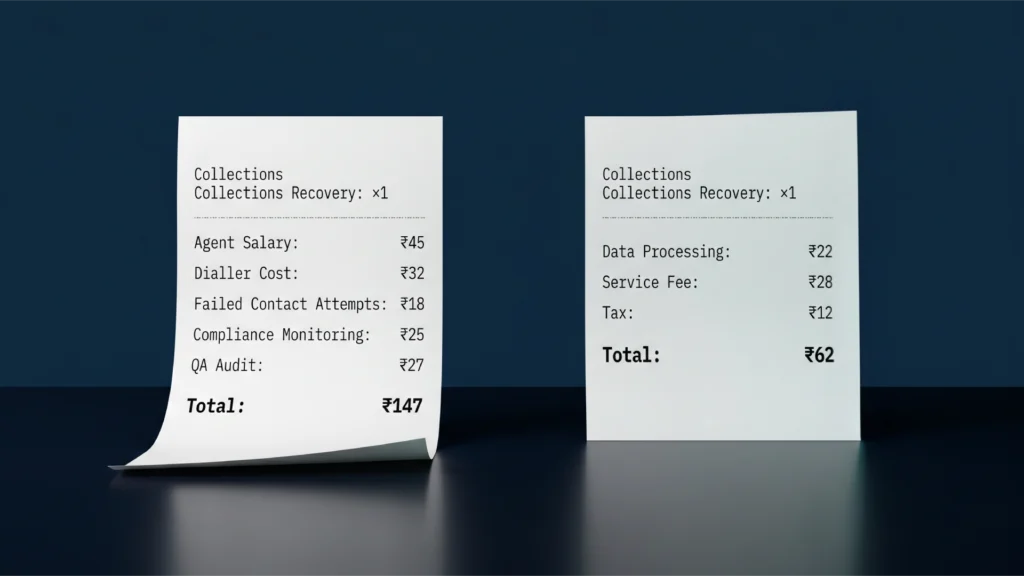
TL;DR The difference between a profitable collections operation and a loss-making one often comes down to a single number: cost per recovery. For Indian NBFCs managing portfolios of Rs. 500 crore or more, that number determines whether the collections function operates as a cost centre or a margin contributor. Collections cost benchmarking for Indian NBFCs […]
Collections Automation ROI for US Banks: 48% Cost Reduction with FDCPA Maintained

TL;DR Every collections leader at a US bank knows the number that keeps the CFO asking questions: cost per recovery. When that figure sits above $100, the collections operation is not just expensive; it is structurally misaligned with the margin profile of most consumer lending portfolios. The real return on collections automation for US banks […]
Right-Party Contact Rate for Indian NBFC Collections: AI Timing vs Manual Dialler Benchmarks

TL;DR Every collections operation has a single metric that determines whether agent hours convert into recovered rupees or vanish into unanswered calls and wrong-party conversations. For Indian NBFCs operating personal loan, two-wheeler, and microfinance portfolios, that metric is the right-party contact rate: the percentage of outbound attempts that reach the actual borrower. The gap between […]
Built From the Inside

What Seven Years of Waiting Taught Me About Building AI It was 2017 and I was in San Francisco to speak at a fraud analytics conference. I had a confirmed slot on the programme, I knew what I was going to say, and I had arrived well in advance. What I hadn’t anticipated was what […]
AI Charged-Off Debt Recovery for US Banks: Improving ROI on Legacy Portfolios

TL;DR A charged-off portfolio on a US bank’s balance sheet has a specific financial character. The accounts have been written down. The provision has been taken. The loss is already on the books. Recovery at this stage is pure upside against a cost base that has already been absorbed. The standard model for working that […]
AI Self-Learning Models for NBFC Collections: How the Technology Works

TL;DR A propensity model deployed on a personal loan portfolio in January was trained on 18 months of historical payment data. At deployment, its scores were accurate. Recovery rates improved through the first quarter. By August, the picture has changed. Payment rates in the mid-propensity band have dropped. The model continues to route accounts to […]
MLOps for SA Credit Providers: What AI Collections Implementation Looks Like

TL;DR Building an AI collections model and running one are two different disciplines. A model that performs well in development can fail in production for reasons that have nothing to do with the quality of the underlying algorithm. The training data becomes stale as the portfolio evolves. The portfolio composition shifts toward product types the […]
Credit Union Collections AI: Balancing Member Relationships and Recovery

TL;DR The member who is 45 days past due on their auto loan is also the member who has held a savings account since 1998. Their spouse has a mortgage with the credit union. Their two adult children opened their first checking accounts at the same branch three years ago. The family’s total deposit relationship […]
AI for Early Bucket Collections: How US Community Banks Reduce 30-60 DPD Loss

TL;DR A US community bank with a $180 million consumer loan portfolio sees between 800 and 1,200 accounts enter the 30-60 DPD bucket every month. The collections team has three full-time agents. With current tools and contact infrastructure, they can realistically work about 600 accounts in a month. The remaining 200 to 600 accounts carry […]
Propensity Scoring for South African Collections: A Practical Introduction

TL;DR A collections manager at a South African retailer credit provider works a 30-60 DPD portfolio of roughly 8,000 accounts every month. Her current system ranks them by outstanding balance. Her team contacts the highest balances first and works down the list. By month end they have reached about 60% of the accounts. The rest […]


