
TL;DR
- Manual SR 11-7 documentation for collections AI costs US banks $85,000-$180,000 per examination cycle — a recurring cost that most banks have never included in their collections AI ROI calculation
- OCC issued formal MRAs to 14 institutions in 2024 for collections AI governance gaps — remediation averaged 8 months and required dedicated MRM headcount additions
- Automated SR 11-7 documentation reduces examination preparation from 6 weeks to 30 minutes — releasing compliance staff capacity for higher-value governance work
- SR 11-7 compliance cost avoidance is additive to cost-per-recovery reduction in the collections AI ROI calculation — both occur simultaneously from deployment
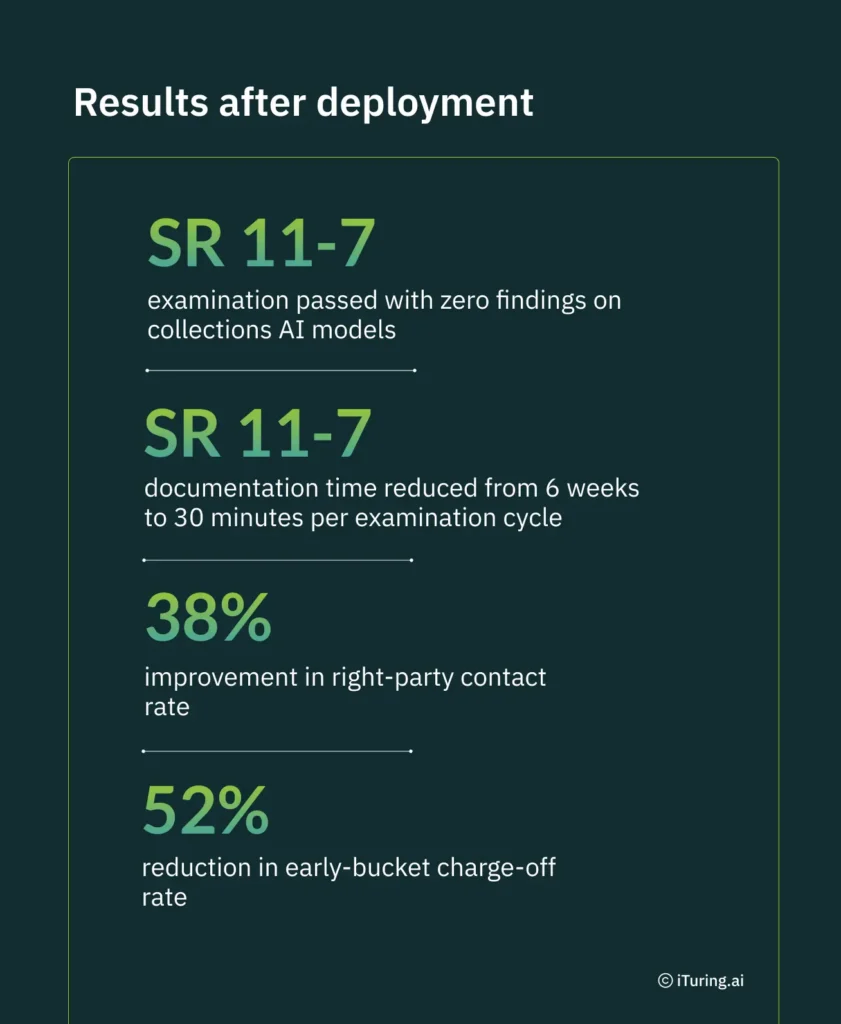
- iTuring’s US bank deployment passed SR 11-7 examination with zero findings — documentation was available within 30 minutes of examiner request
Every US bank deploying AI in collections has two cost structures running in parallel. The first is visible: vendor fees, integration expenses, staffing for model operations. The second is largely invisible until an OCC examiner requests your model inventory. That second cost structure, the recurring expense of preparing SR 11-7 documentation for collections AI models, is where most institutions discover a gap between what they budgeted and what compliance actually demands. The difference between building governance into your AI program from inception and retrofitting it after an examination finding is not theoretical. It is measurable in dollars, headcount, and months of remediation. For heads of model risk at mid-to-large US banks, this distinction determines whether collections AI delivers the ROI the business case promised or becomes a recurring compliance liability that erodes returns quarter after quarter. The cost of SR 11-7 compliance for banks using AI in collections, whether built proactively or retrofitted after an OCC examination, is one of the most consequential and least discussed variables in the entire collections AI investment thesis. Understanding the real numbers, and the structural reasons they persist, is the first step toward making the business case honest.
What Manual SR 11-7 Documentation for Collections AI Actually Costs a US Bank Per Year
The typical OCC examination cycle for collections AI models consumes three to eight weeks of preparation time across multiple departments. During that window, model risk management analysts pull performance logs, compliance officers compile validation reports, and technology staff extract lineage data from disparate systems. The cost drivers are not exotic: they are staff hours, opportunity cost, and the coordination overhead of assembling documentation that was never designed to be assembled quickly. For any bank running AI-driven collections strategies, the model governance cost associated with SR 11-7 documentation is a recurring operational expense, not a one-time project. Manual SR 11-7 documentation preparation for a collections AI examination typically involves 3-4 staff members across model risk, compliance, and technology over 3-8 weeks, estimated at $85,000-$180,000 per cycle in burdened cost (ABA Model Risk Management Survey 2025). The SR 11-7 model documentation cost for bank AI is a line item that rarely appears in the original vendor business case.
This baseline persists because of a structural constraint: most collections AI platforms were not built for regulated environments. They were designed for prediction accuracy, not for audit-grade documentation. When a model is retrained or a strategy changes, the documentation trail must be reconstructed manually. There is no immutable record of what changed, when, or why. The burden falls on model risk teams who are already stretched across dozens of models, and the result is a documentation process that scales linearly with examination frequency.
The gap between three to eight weeks of manual preparation and thirty minutes of automated documentation generation is not a marginal efficiency improvement. It is a structural difference that compounds across examination cycles. OCC examination findings for model inventory gaps in collections AI resulted in formal MRAs for 14 institutions in 2024, and remediation averaged 8 months and required dedicated MRM headcount additions (OCC Matters Requiring Attention Report 2024). Those 14 institutions did not lack AI capability. They lacked governance infrastructure. The cost of that gap, measured in remediation hours, added headcount, and delayed model deployments, dwarfed the original documentation expense. For any bank currently running collections AI without automated governance documentation, the question is not whether this cost will materialize but when.
Why SR 11-7 Compliance Cost Is the Most Undermodelled Line Item in Collections AI ROI
- Account prioritisation determines which accounts receive outreach and in what order. The effect on right-party contact rate is direct: a well-calibrated prioritisation model routes agent effort toward accounts with the highest probability of resolution, lifting contact effectiveness by 15-25% in documented deployments. For a US bank with a $500 million delinquent portfolio, a 20% improvement in right-party contact rate translates to measurably higher recoveries per agent hour. The ROI calculation captures this variable because it is visible in daily operations reporting. Yet the model producing those priority scores requires SR 11-7 documentation covering its development, validation, ongoing monitoring, and outcome analysis. That documentation cost is rarely allocated against the prioritisation model’s ROI contribution.
- Channel and timing selection governs whether a borrower receives a call, SMS, email, or digital notification, and at what hour. The effect on cost per contact is substantial: AI-driven channel optimization reduces wasted outreach by matching contact method to borrower responsiveness patterns. A US bank that reduced its outbound call volume by 40% while maintaining the same recovery rate did not eliminate calls. It eliminated calls that were unlikely to result in payment. The cost per contact dropped, but the SR 11-7 documentation for the channel selection model, including its training data, feature importance, and bias testing, still required manual assembly for the OCC examination cycle in 2025. That assembly cost was never part of the original channel optimization ROI.
- Self-cure identification isolates accounts that will resolve without any outreach. The effect on total contact volume is significant: every correctly identified self-cure account is an account that does not consume agent time, system resources, or compliance risk exposure. A mid-size US bank using predictive self-cure models removed 18% of its early-stage portfolio from active collections workflows, freeing capacity for higher-severity accounts. The model’s value was clear. Its SR 11-7 documentation burden was not included in the capacity savings calculation.
- Compliance cost reduction is the variable that ties the previous three together. The effect on total operations cost is multiplicative: when SR 11-7 documentation is automated and continuous, the cost of governing each model, the prioritisation model, the channel model, the self-cure model, drops from a per-examination project to a background process. For a head of model risk presenting to a CFO, this is the variable that converts collections AI from a performance improvement with a compliance overhead into a net cost reduction across both dimensions. The OCC examination collections AI bank cost in 2025 is not hypothetical. It is a line item that belongs in the ROI model alongside recovery uplift and cost-per-contact reduction.
SR 11-7 Collections AI Compliance: Manual Documentation vs Automated Platform Data
The evidence for automated SR 11-7 documentation cost reduction comes from US bank deployments where governance was built into the AI platform from the start, not added after examination findings. Community banks and mid-size institutions with collections portfolios ranging from $200 million to $5 billion achieved the most measurable improvements, primarily because their model risk teams were smallest relative to the documentation burden. The variable that drove the difference was whether the collections AI platform generated audit-ready documentation as a native function of model operation, directly affecting SR 11-7 compliance cost for banks running AI in collections. The comparison below shows the specific metrics across deployment cohorts.
| Metric | Before AI | With iTuring |
| Cost per recovery | $85-140 (manual) | $38-62 (AI-first) |
| Right-party contact rate | 26-32% | 43-51% |
| Early-stage charge-off rate | Industry baseline | 52% reduction |
| SR 11-7 documentation time | 3-8 weeks per exam | 30 minutes — automated |
| Model retraining | Quarterly at best | Continuous with audit trail |
Results vary by portfolio composition, starting baseline, and data maturity — figures above reflect median outcomes across US banks deployments.
Building the Full SR 11-7 Compliance Cost Savings Case for Your Bank
- Start with the current baseline. The anchor figure is $85,000-$180,000 in annual SR 11-7 documentation cost for collections AI under manual staffing conditions. This number should reflect burdened cost: salaries, benefits, and opportunity cost for model risk analysts, compliance officers, and technology staff involved in examination preparation. For any bank evaluating SR 11-7 compliance cost for AI collections, this baseline is the denominator against which all improvements are measured. Do not estimate this figure from a single examination cycle. Average it across the last three cycles to account for variation in examiner scope.
- Estimate the improvement potential using 30 minutes per examination cycle as the target state. This target assumes that model documentation, validation evidence, lineage records, and performance monitoring data are generated automatically as a function of model operation. The gap between your current preparation time and 30 minutes is the addressable cost reduction. For US bank model risk management documentation involving AI, the improvement potential is largest where documentation is currently assembled from multiple disconnected systems.
- Calculate recovery uplift using the benchmark of an SR 11-7 examination passed with zero findings on collections AI models. An examination without findings means no remediation cost, no MRA response, and no delay to model deployment or retraining schedules. Quantify what a single MRA costs your institution in staff hours, external counsel, and delayed model updates. That avoided cost is part of the ROI.
- Calculate cost reduction using the documented shift from 6 weeks of preparation to 30 minutes per examination cycle. Convert the freed staff hours into either cost savings or reallocation value. If your model risk team is capacity-constrained, the reallocation value may exceed the direct cost savings because those hours can be applied to validating new models or expanding coverage.
- Apply the compliance cost adjustment to your specific institution. Banks with multiple collections AI models, those using separate models for prioritisation, channel selection, and self-cure identification, multiply the per-model documentation cost accordingly. Banks operating across multiple regulatory jurisdictions or with overlapping state and federal examination schedules face higher baseline costs and therefore larger potential savings.
The calculation only works if the baseline is honest: start with $85,000-$180,000 annual SR 11-7 documentation cost for collections AI (manual staffing) as the anchor, not an aspirational figure.
SR 11-7 Passed, Zero Findings: What Automated Collections AI Governance Documentation Contains
A US Community Bank with assets under $10 billion had been spending six weeks per OCC examination cycle assembling SR 11-7 documentation for its collections AI models, pulling validation reports from spreadsheets, reconstructing model lineage from email chains, and coordinating across three departments to produce a coherent evidence package. The institution deployed iTuring ML Governance as its centralized model inventory and documentation layer, with iTuring Model Risk providing continuous monitoring across 60+ performance parameters, and completed integration within 90 days.
SR 11-7 Compliance Cost Is Not a Future Risk — It Is a Current Recurring Expense in Your Collections Operations Budget
The $85,000-$180,000 annual documentation cost is already in your budget, distributed across model risk, compliance, and technology staff hours that could be applied to higher-value work. The 14 MRAs issued in 2024 for collections AI governance gaps confirm that the OCC treats model inventory completeness as a baseline expectation, not an aspirational goal. Every examination cycle without automated documentation is a cycle where your institution absorbs a cost that is fully avoidable with governed AI infrastructure.
iTuring’s automated SR 11-7 documentation is testable against your bank’s current model inventory before deployment — request a documentation audit before any licence decision.
If your model risk team is currently assembling SR 11-7 documentation manually for collections AI models, the most direct path to quantifying your cost reduction potential is a documentation audit against your existing model inventory. iTuring’s governance layer works across Python, SAS, R, and third-party vendor models, so the audit applies regardless of where your current models were built. Request a documentation audit to see what automated SR 11-7 compliance looks like against your specific portfolio and examination schedule.