Personal Loan Collections in India: AI Behavioural Signals for Unsecured Recovery

Unsecured Delinquency Is Rising Even as the Overall Loan Book Looks Healthier Than Ever TL;DR The aggregate Indian banking system NPA story is a genuinely positive one right now, system-wide gross NPAs sit at multi-decade lows. But that headline masks a specific, well-documented divergence: unsecured personal loans are moving in the opposite direction, with delinquencies […]
MSME Loan Collections: How AI Uses Informal Income Signals When Traditional Scoring Fails

The Headline Number Says MSME Lending Is Healthier Than Ever. The RBI’s Own Report Says Look Closer. TL;DR The system-wide MSME story is genuinely a good one, and it’s worth stating plainly rather than manufacturing a crisis that doesn’t exist. Gross NPAs in the MSME book have fallen sharply over the past several years, and […]
FCRA and AI Collections: Bureau Data Obligations That Go Beyond Origination

Clean FCRA Documentation on Underwriting Doesn’t Cover What Collections Is Doing With the Same Bureau Data TL;DR A bank can have a clean, well-documented FCRA compliance program for its underwriting models, permissible purpose logic, dispute workflows, furnishing controls, all built and reviewed. Ask the same institution to produce equivalent documentation for how its collections AI […]
FDCPA Section 807 and AI: When Generated Messages Cross the False Representation Line

A Scripted Letter Can Be Wrong. A Generative System Can Be Wrong Differently, at Scale. TL;DR A collections letter written by a compliance team and approved once can be wrong, but it’s wrong in a way someone already reviewed and signed off on. A generative AI system composing a new message for every borrower, every […]
BNPL Collections in 2026: What Applies Now That the CFPB’s Credit-Card Classification Was Withdrawn

Building Toward a Rule the Bureau Itself Withdrew Solves Nothing TL;DR If your BNPL collections build is still oriented around satisfying the CFPB’s card-issuer classification, it’s worth pausing to check the date. The Bureau withdrew that rule in May 2025 and confirmed the following month it has no intention of bringing it back in that […]
Hardship Workflow Automation: How AI Routes Distressed Borrowers to the Right Programme

Two Borrowers in Identical Distress Shouldn’t Get Different Outcomes Because They Reached Different Agents TL;DR A borrower calls in genuinely struggling. Depending on which agent picks up, on their training, their caseload that day, their read of an ambiguous situation, that borrower gets routed to a forbearance conversation, a payment plan pitch, or nothing more […]
Credit Card Collections AI: How Revolving Behaviour Changes the Propensity Model
Your Installment Model Isn’t Underperforming on Cards. It’s Answering a Different Question. TL;DR A collections model that performs well on personal loans and auto loans, then quietly underperforms the moment it’s pointed at a credit card portfolio, isn’t a model that needs more data. It’s a model answering a question revolving credit doesn’t ask. Why […]
Mortgage Collections and Loss Mitigation AI: Meeting CFPB Servicing Rules Without Manual Intervention
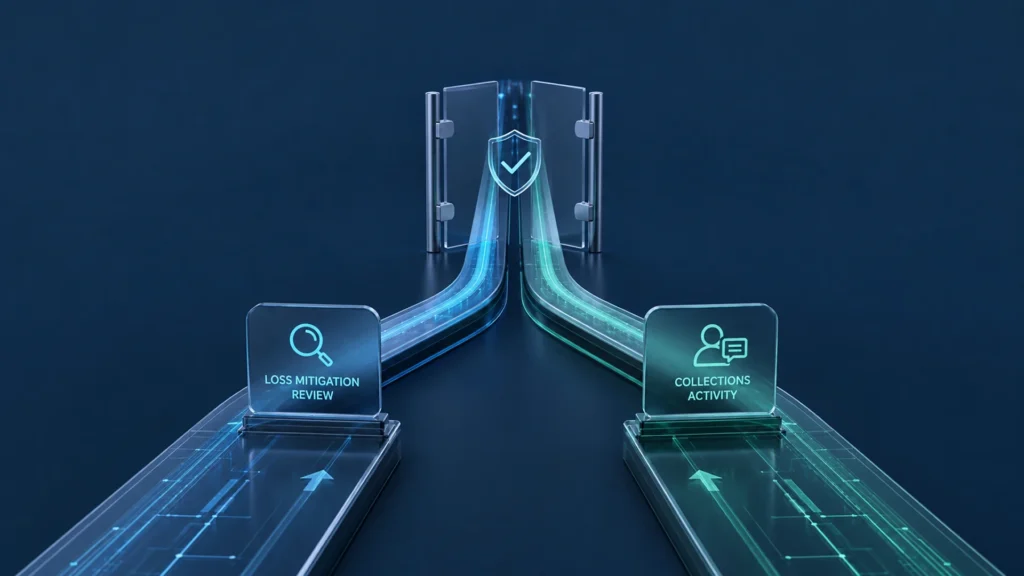
An AI System That Contacts a Borrower Mid-Review Isn’t Efficient. It’s a Violation. TL;DR A mortgage servicer’s AI collections system flags a delinquent account for outreach. The borrower submitted a loss mitigation application eleven days earlier. It’s still under review. The system doesn’t know that, because nobody wired loss mitigation status into the contact decision. […]
NCA Section 86 and AI Collections: Real-Time Debt Review Integration for SA Credit Providers

TL;DR NCA Section 86, AI Collections, and the Case for Real-Time Debt Review Integration South African credit providers running AI-driven collections workflows face a compliance exposure that most batch-based systems cannot close: the gap between when a borrower applies for debt review and when the collections platform actually knows about it. NCA Section 86, as […]
NCA-Compliant AI Collections in South Africa: Debt Review, Conduct, and Section 129 Requirements

TL;DR South African credit providers deploying AI in collections face a compliance problem that batch-based systems cannot solve. The National Credit Act 34 of 2005 (NCA), as amended by the National Credit Amendment Act 2014, together with the NCR Guideline 2023 on AI automated systems, creates a regulatory framework where the timing of each contact […]